
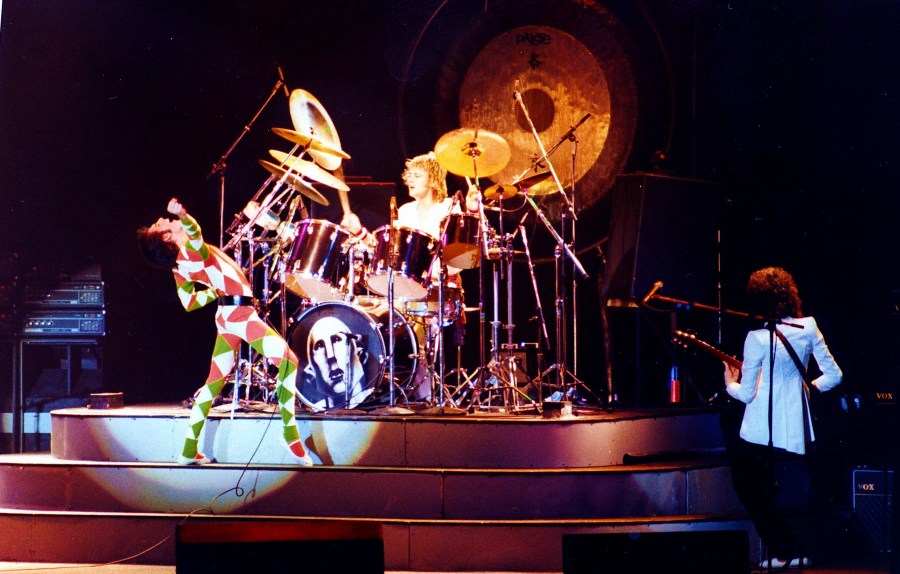
During the 1970s, rock musicians increasingly cultivated a deliberate public image. Greater aesthetic experimentation extended to stage dress, which became an important means of communicating a performer’s musical identity.
Stage costumes and associated visual choices could be intentionally extravagant. They attracted media attention while making performers immediately recognisable to a growing and increasingly attentive audience.
The shift also reflected broader cultural changes after 1968. As concert audiences expanded, stage presentation acquired greater importance: lighting, scenery, effects and costume contributed to performances of increasing theatrical complexity. The concert became a setting in which visual and musical elements jointly shaped the audience’s experience.
Within this relationship between image and sound, early promotional videos anticipated the later conventions of MTV. Glam aesthetics (Note 1) offered performers a vocabulary through which to construct a public persona and determine how it would appear on stage.
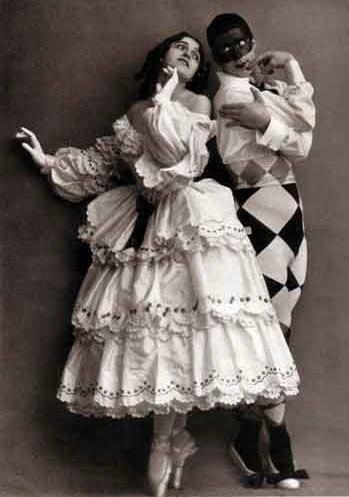
Ballet, and the Ballets Russes in particular, influenced Queen’s stage presentation. The dancer and choreographer Vaslav Nijinsky (1889–1950; Note 2) provided a model for costumes associated with Freddie Mercury, who was also drawn to Jimi Hendrix’s unconventional dress and to garments with Eastern influences. These interests continued to inform Mercury’s later choices, including his appearance with the Royal Ballet in 1979 (Note 3) and an allusion to “Le Sacre du Printemps” in a promotional video (Note 4).
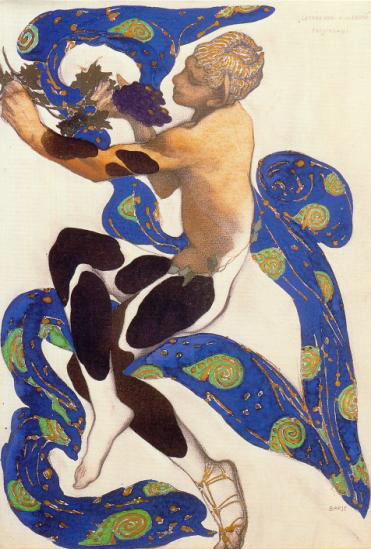
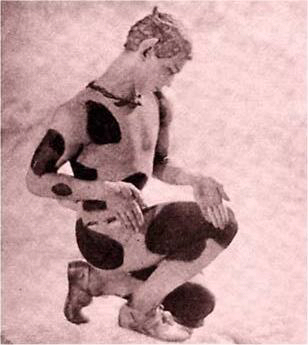
I’m into this ballet thing, and that’s why I’m trying to put across this Nijinsky costume; and trying to put across our music in a more artistic manner than before. A lot of people just dismiss it and say I’m wearing a silly little outfit, rather than being critical and saying that formal ballet may not be quite right for rock ‘n’ roll. (Freddie talking about Nijinsky and ballet in an interview by Tony Stewart for NME, 18 June 1977)
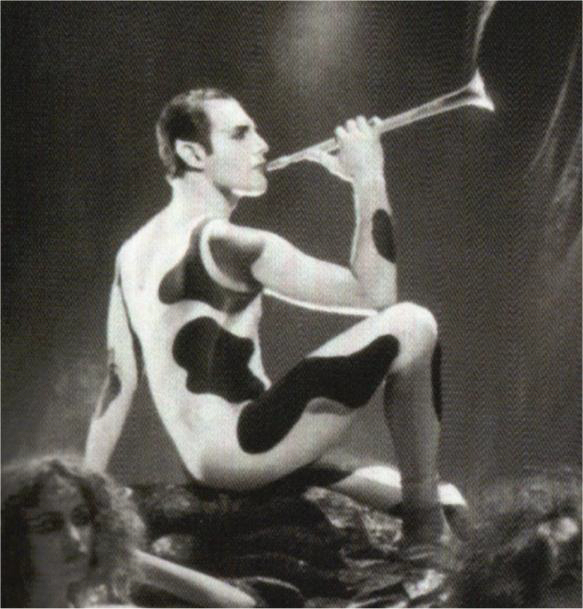
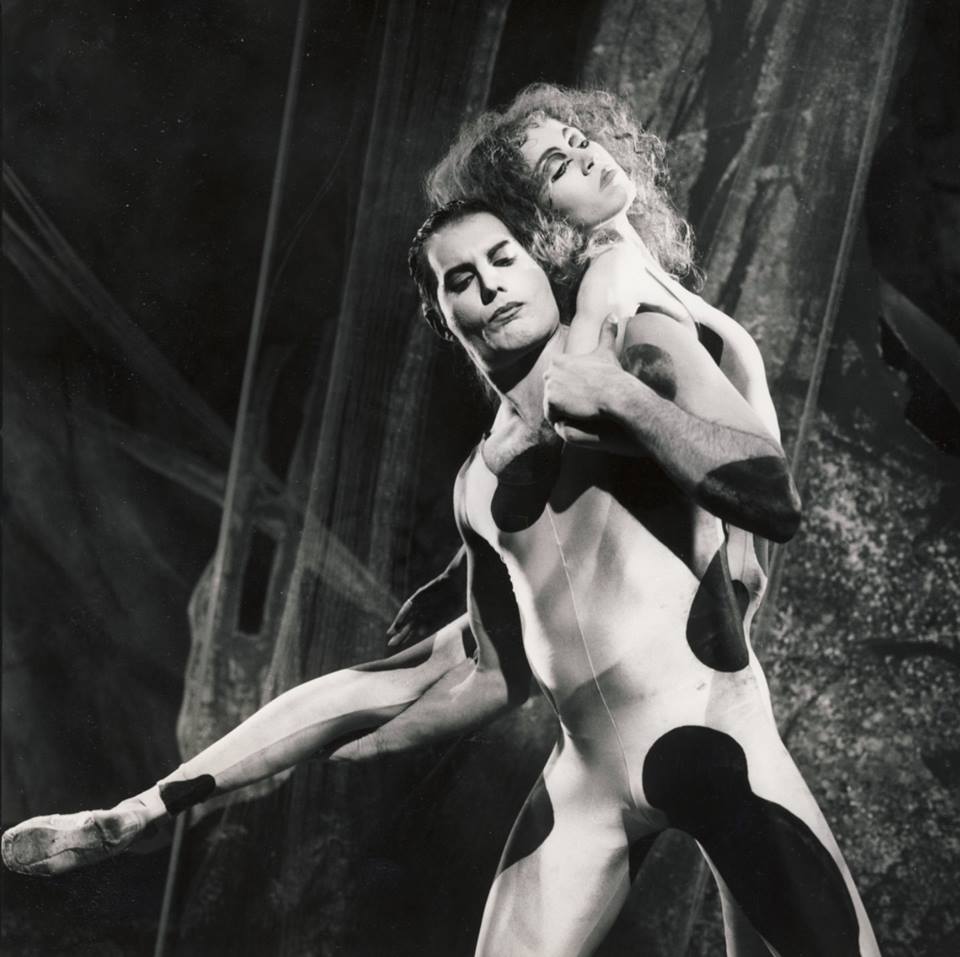
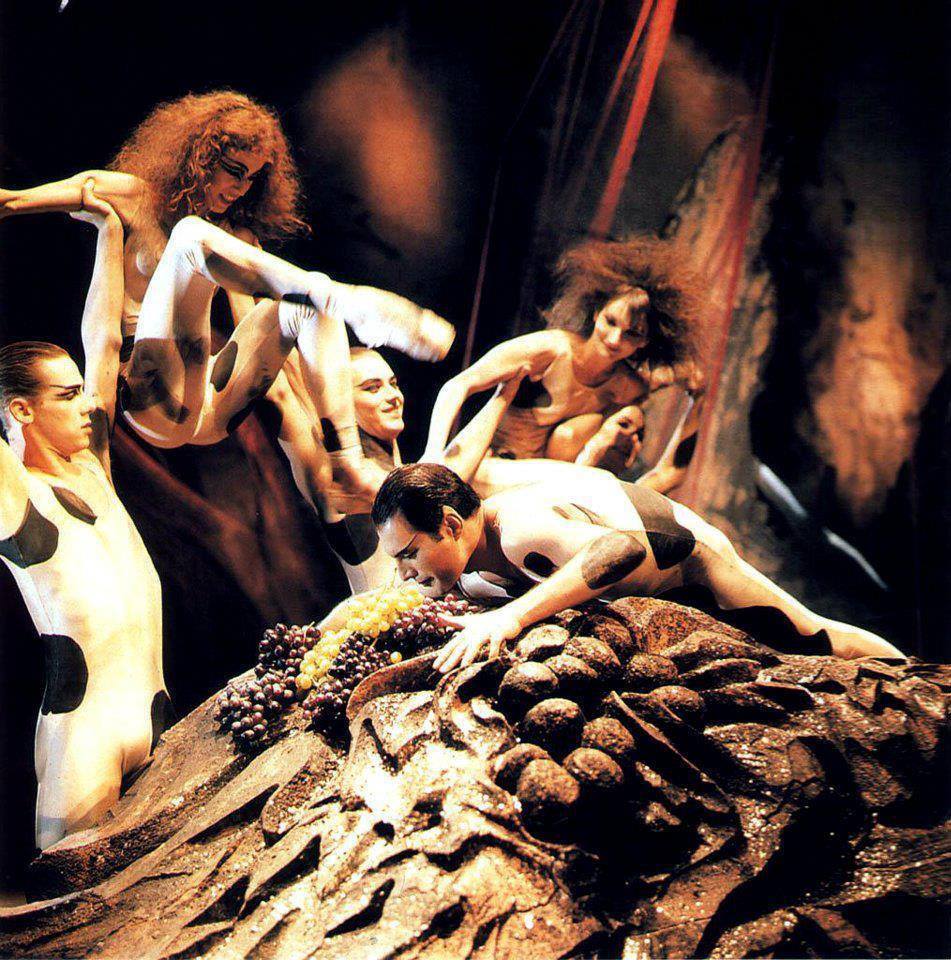
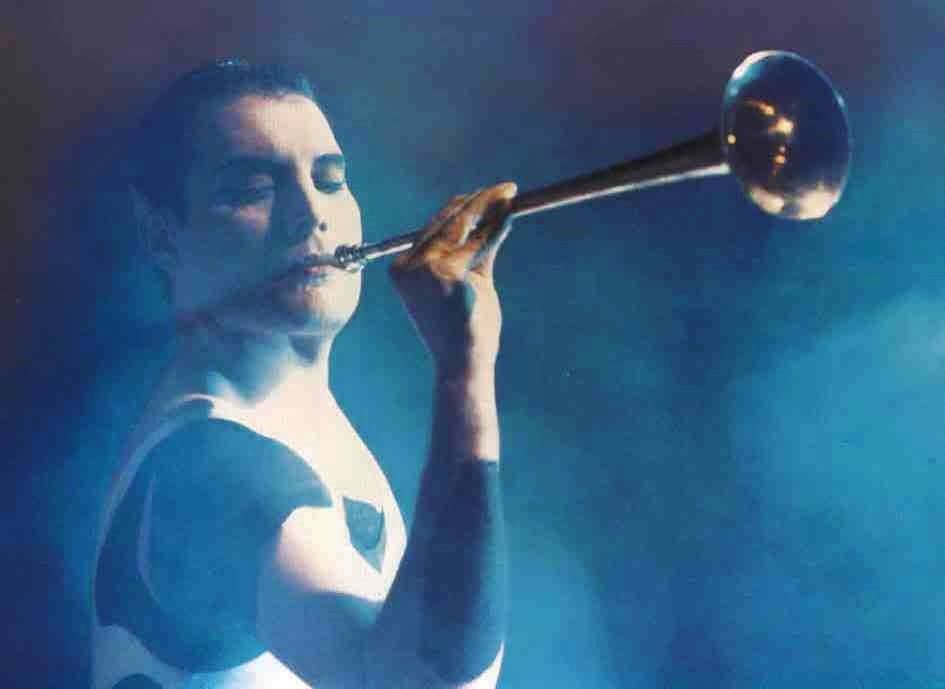
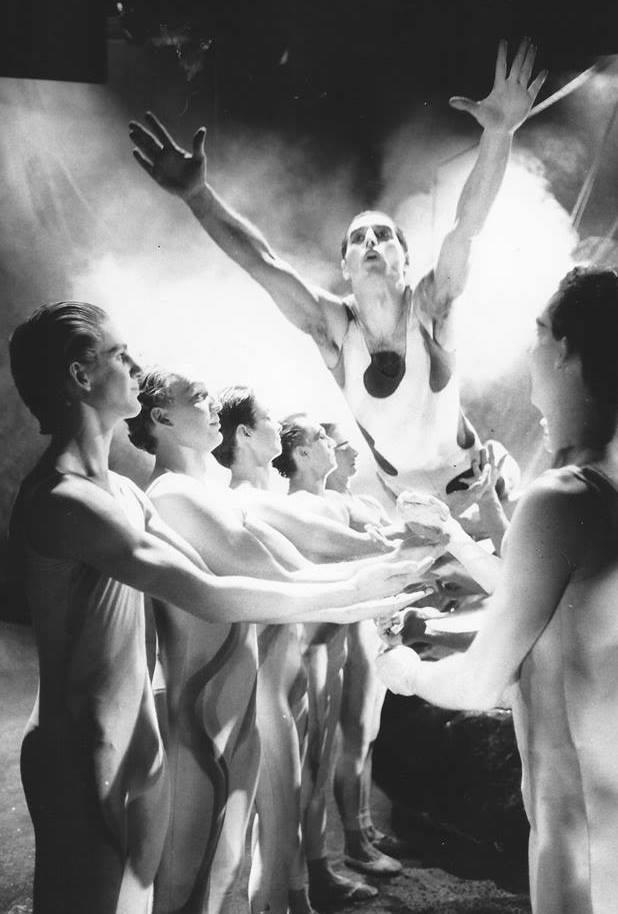
Another relevant figure was the Russian dancer and choreographer Michel Fokine (1880–1942). His principles for twentieth-century ballet (Note 5), particularly their concern with expressive movement and costume, offer a useful context for Mercury’s stage practice:
- create new steps that were not a stereotype but that corresponded to the subject that was being treated.
- the miming and the dancing were to serve as a dramatic action and not used as a simple enjoyment inside a pantomime
- the use of gesture only when required expressively by the style of the ballet
- the corps de ballet must have been expressive in it’s entirety and not as a simple ornament
- the union of dancing with the other arts
The early Ballets Russes sought to move beyond prevailing formal conventions (Note 6). Léon Bakst’s (1866–1924) vividly coloured designs, often drawing on Eastern motifs, were especially influential in creating a sense that dancers inhabited a distinct theatrical world.
Queen’s costumes, particularly Mercury’s, changed across successive tours. At a time when many rock musicians performed in everyday clothes or adopted a uniform group appearance, Queen made dress a conspicuous part of performance. Make-up, jewellery, wigs and other accessories strengthened this visual distinction.
The opening costume of a concert was carefully coordinated with lighting and smoke effects, especially during the 1970s. Such planning aligned Queen’s stage presentation with theatrical and ballet practices that held particular appeal for Mercury.
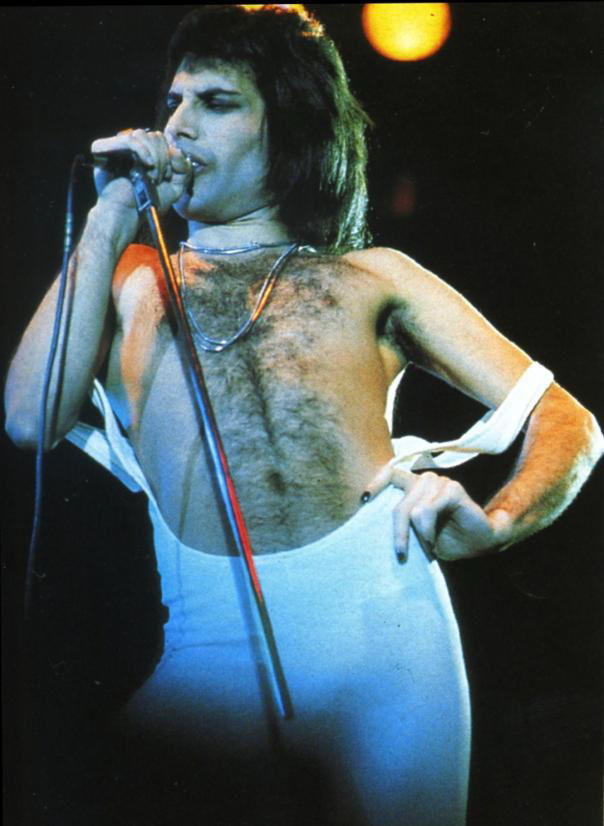
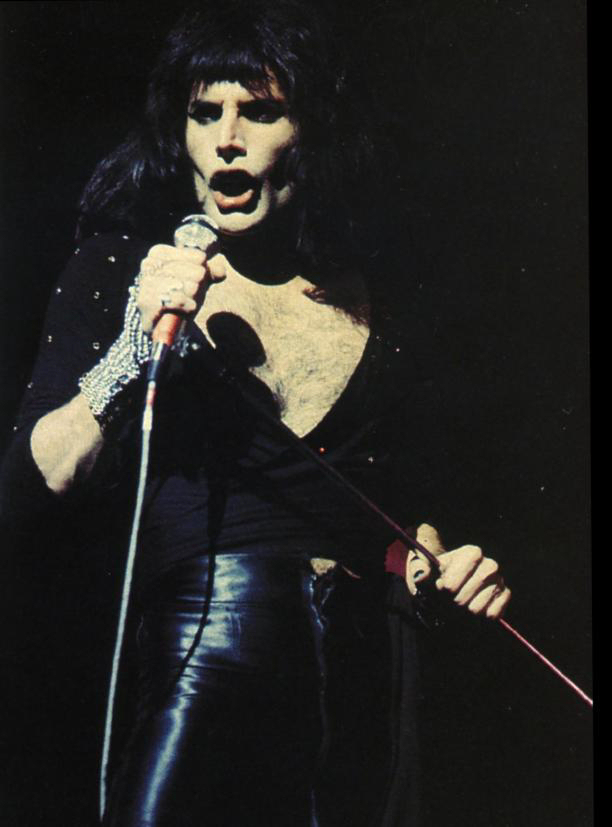
Costume changes within a single concert became increasingly frequent. They were an uncommon feature of rock performance at the time and reinforced the band’s distinctive approach to staging.
Dance also appears as a theme in Queen’s lyrics. In such instances, musical form and verbal imagery work together to evoke bodily movement. The performance connects these elements to choreography, allowing sound, text and gesture to address the same subject through different expressive means.
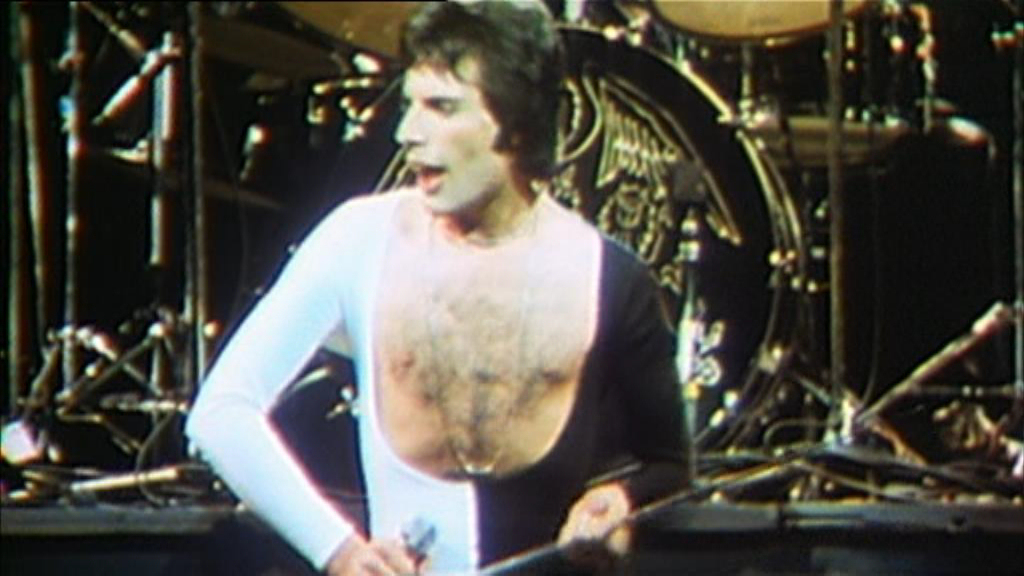
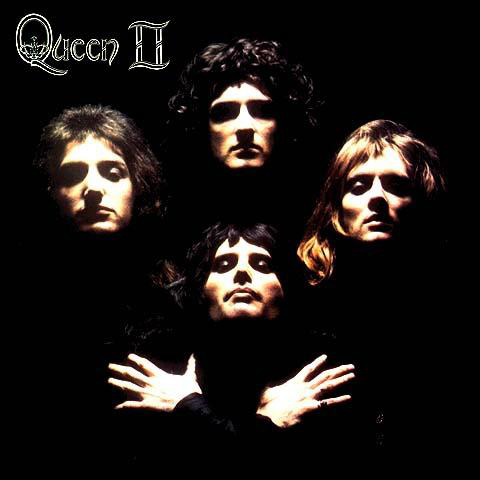
An important feature of early concerts was the contrast between black and white, a duality also developed dramatically and musically on “QUEEN II”. Deliberately conspicuous jewellery heightened the opposition. Rather than cancelling one another out, the contrasting visual modes helped give the concert the form of a staged dramatic event.
The costume worn in the 1977 promotional video for We Are The Champions combined both colours. Their juxtaposition was particularly visible to spectators nearest the stage:
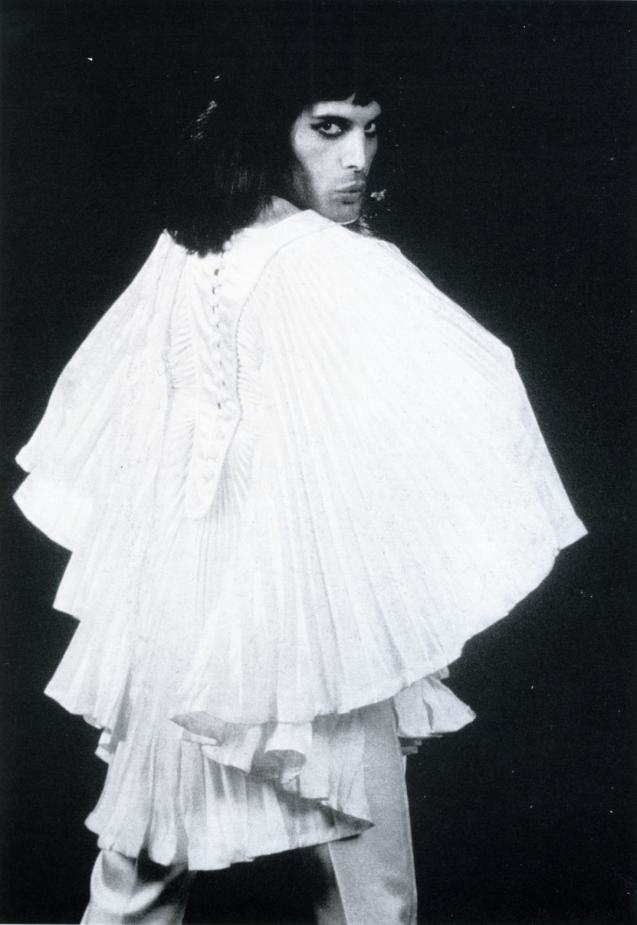
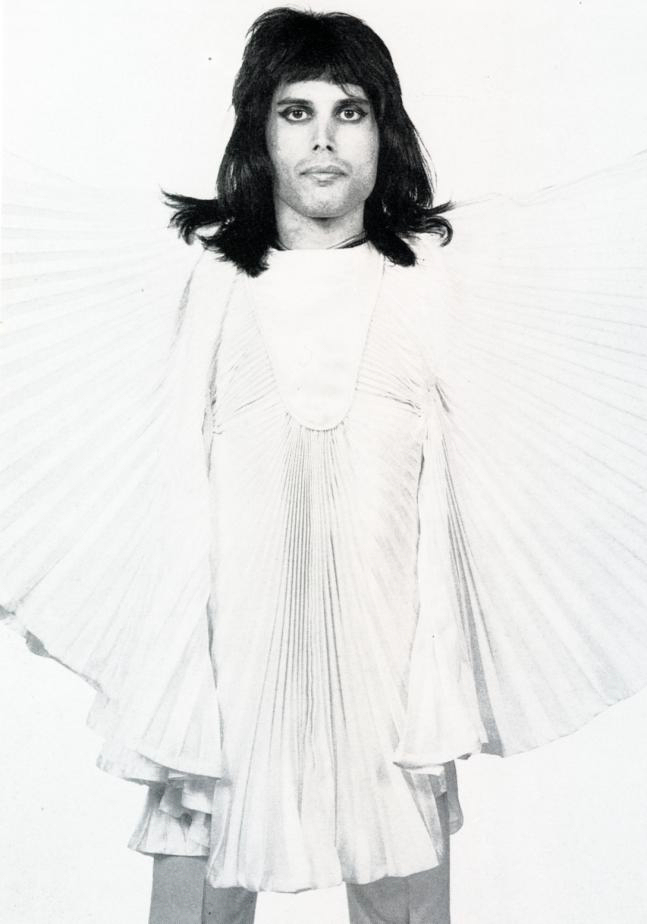
Collaboration with designer Zandra Rhodes, whose work also engaged with glam aesthetics, produced further costumes. Among the best known was the winged design that Mercury specifically requested:
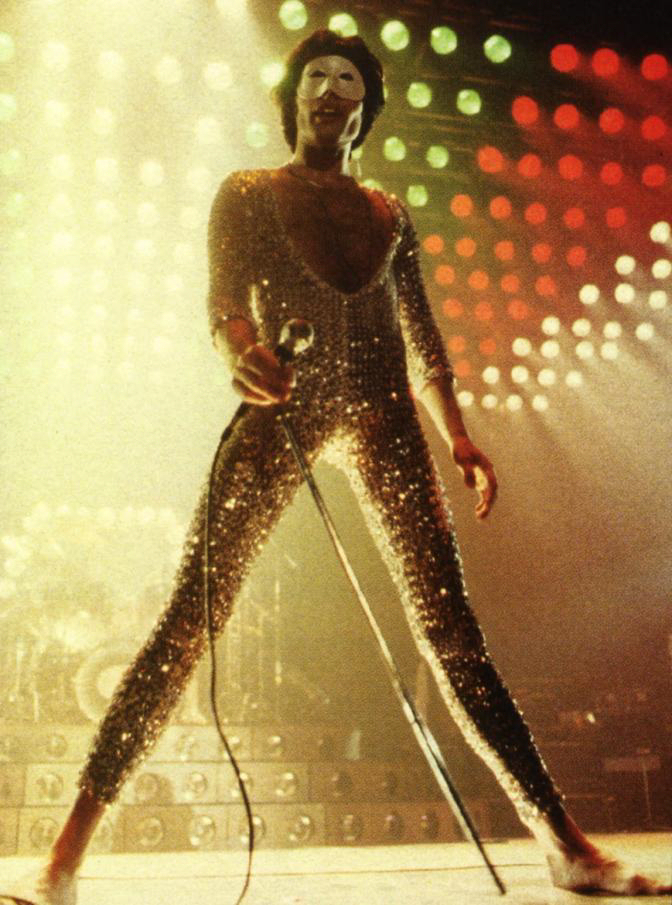
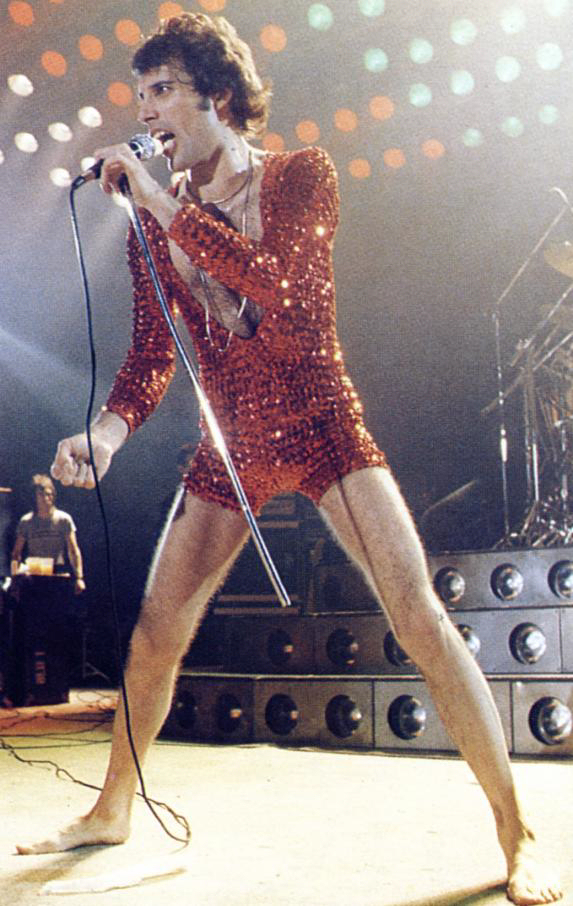
Later costumes retained the close-fitting silhouette of the leotard. Sequins transformed the garment into an ornament intended to catch the light and attract the audience’s gaze:
Other designs drew on the chequered pattern associated with Harlequin. A mask sometimes accompanied the costume, intensifying its carnivalesque and theatrical effect:
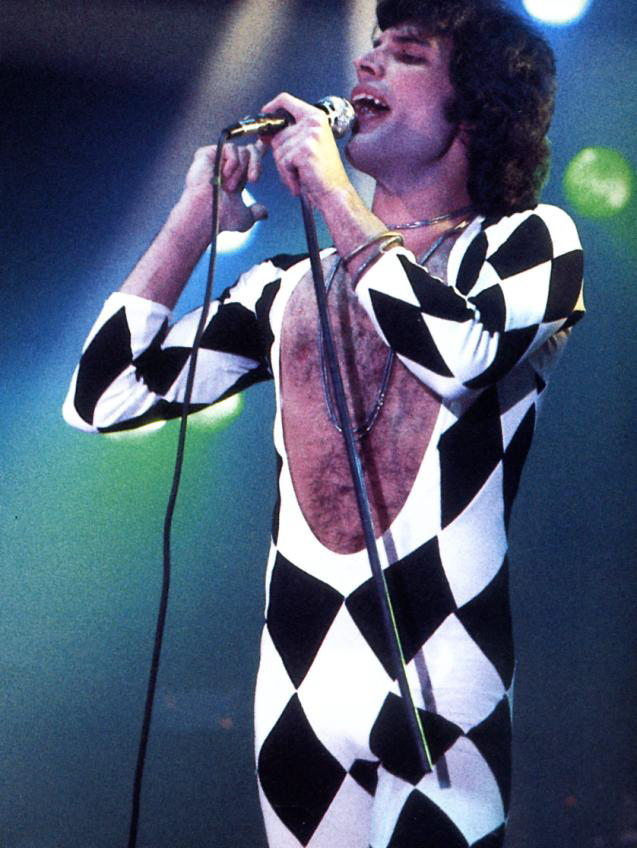
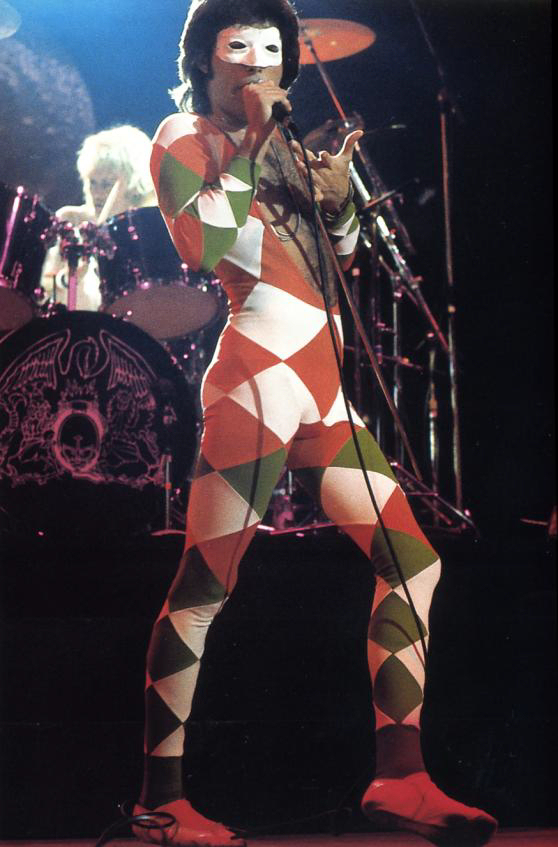
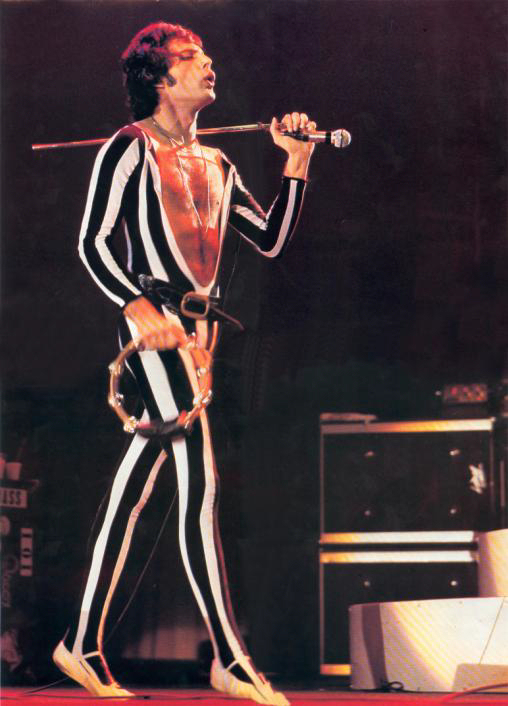
Geometric designs also appeared, including vertical stripes arranged to emphasise the contrast between black and white. Light-coloured footwear further recalled elements of classical ballet:
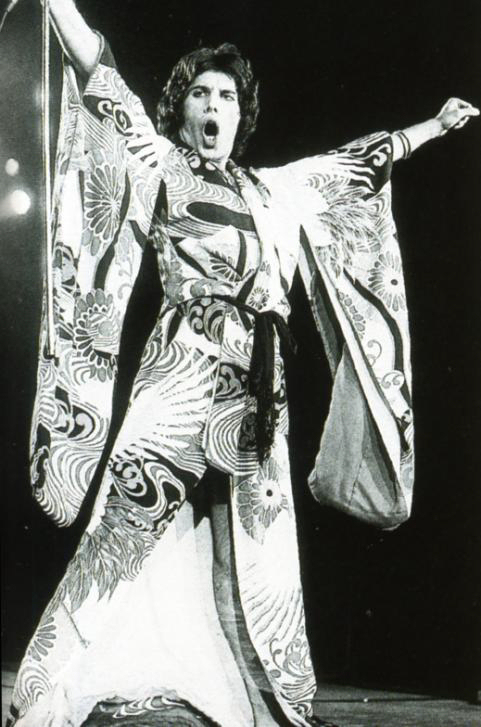
Garments with Eastern influences, including kimonos and loose robes, had a particularly strong effect on Mercury’s movement across the stage. Their fabric expanded when he opened his arms, producing a striking theatrical silhouette associated especially with Queen’s 1970s performances:
The elaborate costume designs became less prominent over time, alongside changes in Queen’s musical and lyrical forms. Nevertheless, the band maintained a distinctive visual identity rather than simply adopting contemporary fashions, such as the jacket-and-tie look associated with aspects of 1980s British new wave.
Queen’s early coordinated appearance gave way to more individual forms of dress. Where the initial group image could recall bands such as the Beatles, the later emphasis on each member’s preferences produced a broader range of visual styles.
Mercury’s solo work and promotional videos likewise relied on considered scenery and visual effects. Stage costume can therefore be studied as part of musical iconography, alongside album and single covers, videos and publicity photographs. Each medium contributes to the construction of an artist’s public image.
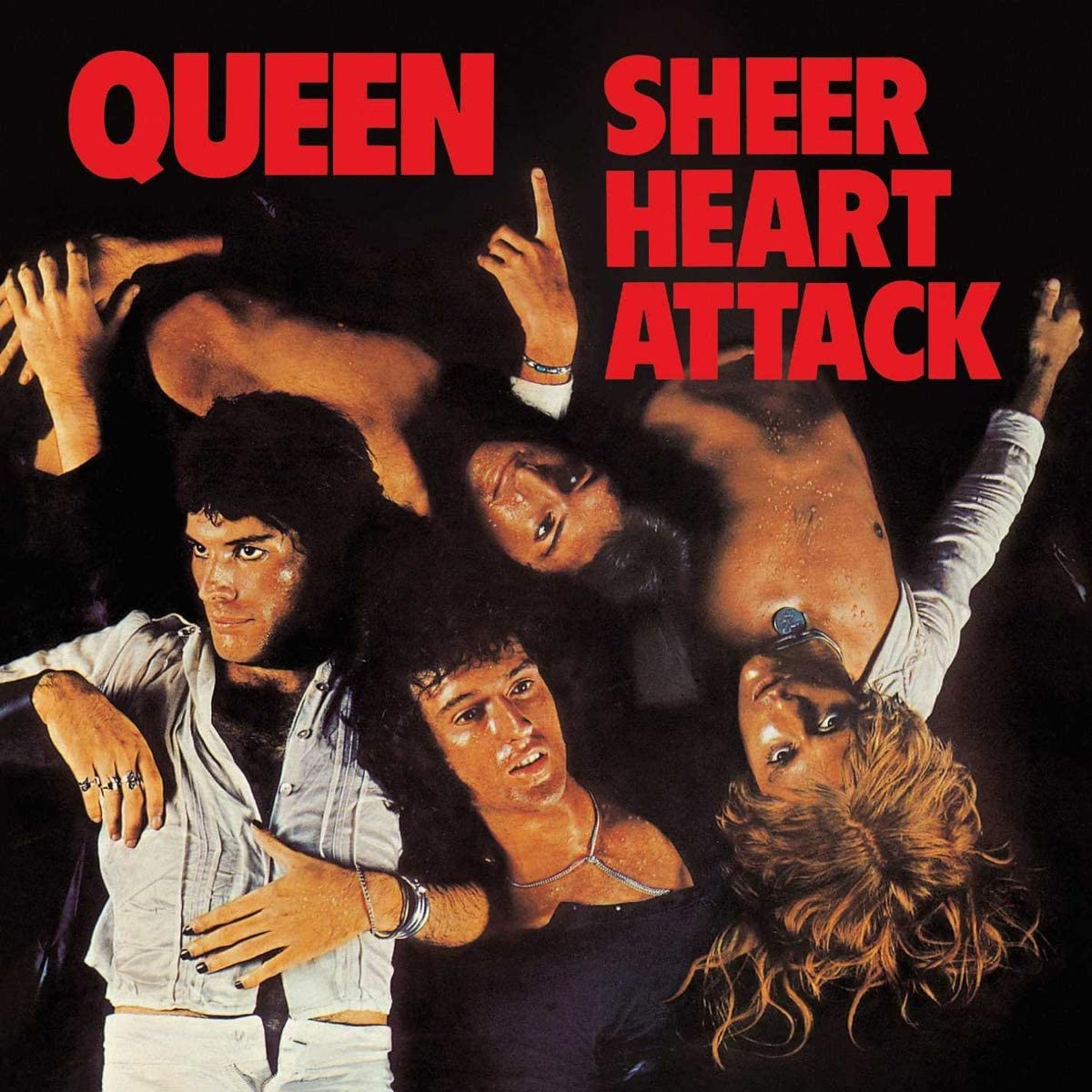
Only a small number of Queen’s record covers explicitly foreground the glam aesthetic in the band’s clothing and arrangement (Note 7). “QUEEN II” and “SHEER HEART ATTACK”, both issued in 1974 and photographed by Mick Rock, are particularly relevant examples:
A popular song circulates through several media and acquires meanings beyond its recorded sound. Studying the iconography of a concert—including costume, jewellery, movement and scenery—therefore helps situate the performer within a wider cultural and visual context.
Music is identified with the artist, that becomes the unique show stealer. The audience don’t want to listen, they want to see: the performance is not the listening of the interpretation of the songs, like in the traditional pre-Rock and Roll: it’s the vision of a dramatic scene put up by music and of an actor who interprets, the musician […] In this dimension the pop performance is distinguished by other types of performances (theatrical, film wise and television wise): an immediate communication feedback and an interaction with the artist is requested from the public – the musician that plays an instrument […] The performance of pop music intended as communication is the creation of a text by means of act […] From a communicative point of view, pop performance in other words is the dramatized representation of one or more songs: like such it uses a theatrical language. […] Pop performance is then the putting up of a show of a symbolic universe in which the actors (the musicians and the public) communicate and swap messages: the songs become one with the body movements [and costume choices] of the interpreter and of the scene. The pop performance was born as a musical interpretation, but it becomes a recital tout court. This dramatized version of pop performance is particularly evident if you think of the English meaning of the verb “to play”, that is translated as to “play” (music) […] or as to play (theatre wise) […]. As of dramatizing one or more songs, each performance –“ live” – or medial (like video clips) is based on a series of codes and conventions that derive majorly from the theatre. (Note 8)
Within this account of live performance, costumes, choreography and stage design function as elements of a shared visual language:
Pop performance is a bodily story […] it’s a sort of “rhetorical gesture” in which acting (the use of the space to interact in, takes form like the relationship between stage and stalls) prevails on all other kinds of messages. In the pop performance the body of the performer is used like a text, to which is given meanings that are part of the story of the performer. One can identify two kinds of meanings given to the body of the performer:
- the visible presentation of the body (the look)
- the movements as signs: the non verbal communication (gesture and dancing). (Note 9)
Stage presence creates a relatively immediate visual relationship with both the audience and the media. This interaction is one reason to understand a Queen concert as a theatrical event.
© Nicola Bizzo
(1) The Glam Rock or Glitter Rock is a kind of Rock & Roll that was popular in the 70’s, especially in the U.K. and in the major U.S. cities like New York and Detroit, and progressively it came to an end (except for some groups that tried to revive it at a distance of nearly thirty years like Darkness or similar). This kind of music gets its name by the kind of dressing they used “Glamour”, it researches a cured, coloured and striking look that characterizes the exponents during their public appearances like the meetings with the press or the presentation of a record. Born like a main British phenomenon, and the major popularity is found between the 1971 and 1973, in the United States this kind of music has a lower level of success due to a more conservative vision, none the less it present with groups like the Kiss, New York Dolls, or in the area of Detroit with groups like Iggy Pop, Alice Cooper and others. This kind of music is distinguished by their scenery costumes made of aluminium foil, glitter, sequins, studs and other striking and sparkling objects (very characteristic is the showing off of false jewellery), nevertheless not very different by the ones showed off by Liberace, Elvis Presley and other artists during their performances in public places; it is also true that a few stylists take care to design original costumes that can increase the impact of the artist on stage. One of the best examples in these years is David Bowie in his “Ziggy Stardust” and “Aladdin Shane” period, that loved to surprise the public and the critics appearing always in strange ways. The artist often show a sexual ambiguity and in general a costume freedom partly given by the previous decade and partly dictated by the will to shock. Among the founders of the Glam Rock are often indicated, Marc Bolan, guitarist, singer and leader of T – Rex, and David Bowie. Other important exponents were the Slade, Mud, Gary Glitter, Sweet, Mott the Hoople, Queen and the first Roxy Music with Brian Eno. It is a common use in the period throughout the 70’s to appear on stage not only with what fashion in that period requires (it being Glam or not) but with the declared willingness to surprise and to scandalize; and so in this particular iconography it is possible to cite other artists – like Elton John or the Aerosmith – not declared Glam but that appear in public with striking and willingly excessive clothing (and that often cite other costumes). http://en.wikipedia.org/wiki/Glam_rock.
(2) The sketch for Nijinsky’s costume to which we refer was designed by the Russian artist and costume designer Léon Bakst, (collaborator of Diaghilev) around 1912 for the show “L’Après-midi d’un faune” with music of Debussy and inspired by the homonymous poet of Stéphane Mallarmé, a script fundamental not only for the history of French Symbolism, but aware of the development of modernism in art.
(3) For more details see JACKY GUNN & JIM JENKINS, Queen – the official biography, Milan, Arcana Editrice,1993, pages 139-140.
(4) Also the video I want to break free (later cited in that of The Great Pretender) recreates the atmosphere of “L’Après-midi d’un faune” of Debussy, a ballet brought to fame by Nijinskij. For the scenes taken from the “Le Sacre du Printemps” the song of reference, and as a consequence the promotional video, is Made in Heaven.
(5) Such programme points were published on the The Times of London in 1914.
(6) Also in the world of painting and of contemporary visual arts there is a research of a new dynamism, and not intended only in the futuristic sense.
(7) The creation of a definite image across the LP covers does not take place. Something that happens with other contemporary groups as Pink Floyd that thanks to the works of the artist Storm Thorgenson build a visionary and surreal imaginary.
(8) GIANNI SIBILLA, I linguaggi della musica pop, Milan, Bompiani 2003 pages 164 and following.
(9) Ibidem
Related collections: For related stage imagery and performance history, explore the Stormtroopers in Stilettos exhibition photographs and the Queen concertography.
Related Articles


You must be logged in to post a comment.